
Seven Army soldiers were killed and 19 others injured in the Tuktuk sector of Ladakh on Friday when the vehicle they were travelling skidded off the road and fell into the Shyok river, Army officials said.

The T-72 tank with five soldiers on board sank due to flash floods while they were crossing the river.

The amazing story of how a little known cheese from Ladakh stunned the world!

The forward airbase near the PoK-China border, which from where Pakistan is around 50 kilometres and the strategic Daulat Beg Oldi is around 80 kilometres, the activity of fighter, transport aircraft and helicopters is going on during both day and night.
The 60-metre bridge is around four kilometres east of the confluence of Shyok and Galwan rivers, and links the narrow mountainous region to the Shyok-Daulat Beg Oldi road.
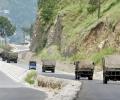
Sources said the work has already started on this project and the new road will connect Manali with Leh near Nimu where Prime Minister Narendra Modi had recently visited during the ongoing conflict with China.
Within the army, there is growing concern that New Delhi will allow the Chinese to retain the territory they have occupied in the last month.

The use of the strategic road by the Indian security forces from Leh has helped in reducing the travel time between Leh and DBO to six hours.
Since the June 15 clash, the PLA has inducted large numbers of troops, armoured vehicles and artillery along the LAC, from Depsang and Galwan in northern Ladakh to Hot Springs, Pangong Tso, and Chushul in central Ladakh, to Demchok and Chumar in southern Ladakh.
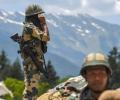
'I am ashamed we are dealing with such adversaries.'
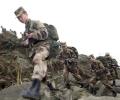
The Indian Army has been slow to react. Indian troops have deployed in the vicinity of PLA incursions, but there are no attempts to outflank Chinese positions.

Indians are becoming much more spendy and discerning travellers and look for places that can offer them a 'new' kind of experience.
'The Indian Army's surveillance had noticed the Chinese movements.' 'There was no intelligence failure.'
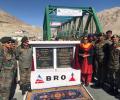
'These combat engineer units are used in war for building bridges for advancing troops.' 'Instead of training by building bridges over the Mula and Mutha rivers in Pune, they will practice by building bridges in Mumbai,' Indian Army chief General Bipin Rawat tells Ajai Shukla.
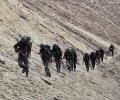
The government needs to answer the critical question of whether it has accepted any restrictions on its infrastructure creation activities, asserts Ajai Shukla.

In underlining the role of border villages as custodians of India's frontiers, New Delhi is following China's example in Tibet.
'If we had sent a few airplanes (into Tibet), we could have wiped the Chinese out.' 'And everything could have been different in the 1962 War.' 'They did not believe me there was no Chinese air force.' 'Can you imagine what would have happened if we had used the IAF at that time?' 'The Chinese would have never dared do anything down the line.'

Sources said that even though India and China have been talking at the diplomatic and the military level for over six weeks now, there has been no thinning down in troop numbers or equipment by the Chinese side on this front.
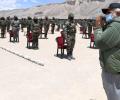
'By not even acknowledging China's occupation of Indian territory Modi signalled to Beijing that he was not prepared to used forceful means to vacate the Chinese occupation, and that his government was reconciled to this loss of territory and accepted the fait accompli engineered by the PLA.'

'China will do everything to hamper our ability to be a competitor.' 'China wants every country in the region to be subservient and we are the biggest stumbling block.'

Glaciers in the Karakoram region are in a stable condition, but those feeding the Ganga and the Brahmaputra river basins are melting at a faster rate, the earth sciences ministry has said.

'The intentions are clear as day! Let India build the infrastructure, then they will claim the land and use the infrastructure to their benefit.' Air Commodore Nitin Sathe (retd) speaks to IAF veterans who have flown in the Galwan Valley long before it became today's headlines.
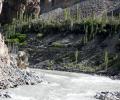
The three-day meeting between the two commissioners of PCIW completed discussions on all agenda items on Wednesday.
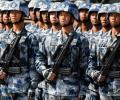
With the Indian Army having blocked the PLA several kilometres inside India, hundreds of soldiers from both sides remain in a tense face-off.

During the visit, she reviewed the security situation in the border region and inaugurated a bridge that will link Leh to Karakoram, providing connectivity on the strategically important Darbuk-Shyok-Daulat Beg Olde axis for military transport.

The talks as part of the annual Permanent Indus Commission meeting are being held after a gap of over two years.

Through the past 18-month period, peace has prevailed in the disputed border regions, which was immensely helpful in the difficult situation that the country was passing through, observes Ambassador M K Bhadrakumar.

'This was Indian land the PLA advanced on and occupied.' 'The Chinese then 'negotiated' a pullback of their troops a small distance on Indian territory even as Indian jawans draw back further into India from the forward position.' 'An apparently satisfied Indian government says this is a great move for peace! How great is that for China!'
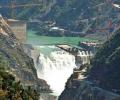
This will be the annual meeting of the Permanent Indus Commission. Under the provisions of the Indus Water Treaty, both the commissioners are required to meet at least once a year alternately in India and Pakistan.
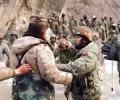
Some may see China's decision to antagonise India as strategically unwise. But China believes its prestige demands standing up to India, whatever the cost.
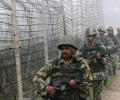
Most of India's reserves for war in the mountains have been sucked in by the standoff with China. A large part of India's airpower has also similarly been committed on the eastern border. By moving these reserves to the China border, India has been weakened vis-a-vis Pakistan. All in all, the nightmare scenario for India of a two-front war may well come true, warns Colonel Anil A Athale (retd).
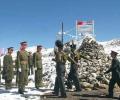
'We will not accept these misadventures by the Chinese.'

Until last month more than two-thirds of the Indian Army was deployed against Pakistan. Of 14 army corps, just four-and-a-half faced China, while more than twice that number was ranged against Pakistan.

The step has been taken to boost tourism in Ladakh and give people a window to appreciate the tough work done by Army jawans and engineers in extreme weather and inhospitable terrains, he said.

'All the government needs to do is to identify clear political and strategic objectives and to give the military planners a free hand,' asserts Ajai Shukla.

A total of around 100 troops took part in the operations from the Indian side while the Chinese had over 350 people on the location.
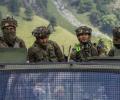
Today, the Ladakhis and Tibetans have been joined by the Sikhs, the Madrassis, the Garhwalis, the Rajputs, who are well trained psychologically and otherwise, to defend the nation, observes Claude Arpi.

Here are 5 ways to soak in the wild beauty of the snowy outdoors. Take your pick!

With the two armies again in a face-off at multiple points, there is apprehension of renewed clashes.

Twenty-two British and French trekkers, stranded in high altitude Ladakh region of Jammu and Kashmir following heavy downpour, have been rescued by Indian Air Force personnel in the past two days.
